Booking the wrong vehicle is the most common mistake in local goods delivery. Book too small and you end up with a second trip, goods left on the pavement, or a driver who cannot safely take the load. Book too big and you pay for space you never use, and you may struggle to get a large vehicle down a narrow lane to the door.
The good news: choosing well takes about two minutes if you know three numbers and a few rules of thumb.
Start with three numbers
- Total weight: weigh the goods, or add up the weights printed on cartons and sacks. Guessing is how overloading happens.
- Size of the biggest single item: length, width and height. A sofa, a door or a steel pipe can decide the vehicle on its own, whatever the total weight.
- Number of pieces: twenty small cartons take more space than their weight suggests, and every piece has to be loaded by hand.
Then add two practical questions: is anything fragile or moisture-sensitive, and how easy is access at both ends (lift, stairs, narrow gate, basement parking)?
The six vehicle classes, and what each suits
Bookroket’s within-city service offers six vehicle classes. The weights below are the maximum load each class is listed for. Leave yourself a margin rather than booking right at the limit.
- Two-wheeler (up to 20 kg): documents, a single small carton, spare parts, samples or a tiffin-sized parcel. If it fits in a delivery bag or on a rear carrier, this is your vehicle.
- 3-wheeler (up to 500 kg): shop restocking, several cartons or sacks, a small appliance, or a batch of e-commerce returns. The workhorse for small businesses moving goods across town.
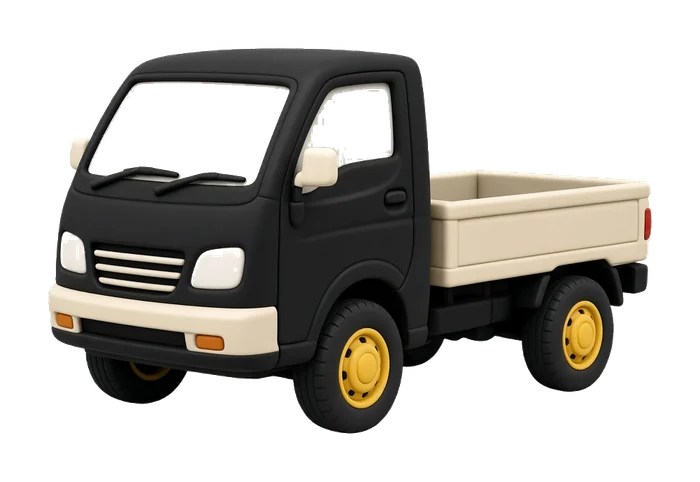
- Tata Ace (up to 750 kg): bulky single items like a fridge, washing machine or a few pieces of furniture, or a larger mixed load of cartons. Compact enough for most city streets.
- Pickup 8ft (up to 1,200 kg): longer items such as doors, panels, pipes or timber that need a longer deck, and heavier loads that would overload a Tata Ace.
- Tata 407 (up to 2,500 kg): bulk stock transfers between a warehouse and a shop, construction material, or a large one-time move of business goods.
- Truck 14ft (up to 3,500 kg): the largest within-city class, for the heaviest and most voluminous loads, such as event set-ups, palletised stock or a full store transfer.
Weight is not the only limit: think about volume
Light but bulky goods fill a vehicle long before they reach its weight limit. Foam mattresses, plastic chairs, empty crates, pillows and packaging material are classic examples. If your load is light but takes up a lot of floor space, size up by one class.
Long items need the deck length, not just the payload. A 7-foot item will not travel safely in a vehicle with a shorter cargo bed, even if it weighs very little. Hanging goods off the back of a vehicle is unsafe and can attract a challan.
Quick rules of thumb
- One or two small packages, under 20 kg in total: two-wheeler.
- Several cartons or sacks adding up to a few hundred kg: 3-wheeler.
- Up to about 750 kg, or one or two large appliances or furniture pieces: Tata Ace.
- Long items, or loads up to 1.2 tonnes: Pickup 8ft.
- Loads up to 2.5 tonnes: Tata 407.
- Up to 3.5 tonnes, or the most cargo space you can get within the city: Truck 14ft.
- More than that: split the load across two vehicles rather than overloading one.
Do not overload — it is unsafe and illegal
Every goods vehicle has a permissible weight, and the Motor Vehicles Act, 1988 penalises driving a vehicle that exceeds it. Overloading also hurts braking and steering. If you are unsure whether a load fits a class, choose the next one up.
Match the vehicle to the type of goods
- Fragile goods (glass, ceramics, electronics): a vehicle with room to spare, so nothing has to be stacked on top.
- Moisture-sensitive goods (paper, textiles, flour, electronics): ask the driver over chat whether the vehicle is covered, and wrap the goods in plastic sheeting, especially during the monsoon.
- Heavy, dense items (machine parts, tiles, metal): weight runs out before space does, so book on weight and keep a margin.
A quick checklist before you book
- Checked access at pickup and drop: lane width, lift, stairs, gate timings.
- Decided who will load and unload, and agreed it with the driver over chat.
- Packed, taped and labelled every piece with the receiver’s name and phone number.
- Kept someone at each end ready for the pickup OTP and delivery OTP handovers.
How this works on Bookroket
When you book a within-city delivery on Bookroket, you choose one of these six vehicle classes. The booking is offered to nearby drivers with that class of vehicle, and once a driver accepts you can chat with them directly to sort out access or loading. Goods are handed over against a pickup OTP and received against a delivery OTP, so both ends of the trip are confirmed. Where Bookroket stands today: we are starting with same-day, within-city goods delivery in Hyderabad, with a matched driver and a vehicle sized to your load. Outstation (city-to-city) shipping through verified transport partners, priced per kg for what you ship and billed once, is coming soon. The Bookroket app is not in the app stores yet.